
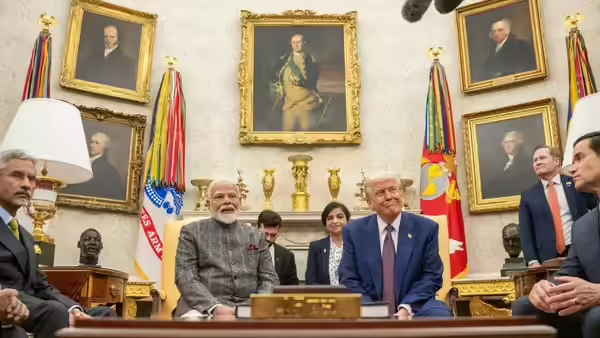
PM Modi’s Reluctance to Call Trump: Did It Cost India a Trade Deal?
Date: January 9, 2026
By: Your News Site Name
In a striking revelation that has sparked debate across diplomatic, economic, and political circles, U.S. Commerce Secretary Howard Lutnick has claimed that a potential India–U.S. trade deal was derailed not by policy differences, but by a missed phone call between Prime Minister Narendra Modi and former U.S. President Donald Trump.
Lutnick made the comments during an appearance on the All-In Podcast on January 9, 2026, asserting that negotiations for a bilateral trade agreement were “set up” and nearly concluded — but a final personal conversation between the two leaders was never held.
“It Was His Deal … You Just Needed Modi to Call”
According to Lutnick, who played a central role in trade negotiations under the Trump administration, the groundwork for a comprehensive trade deal was largely complete. However, he suggested that Trump’s personal style of diplomacy — relying on direct leader-to-leader engagement — made a phone call from PM Modi essential to finalize the pact.
“I set the deal up. But let’s be clear, it’s his (Trump’s) deal. He is the closer. You just had to have Modi call the President. They (India) were uncomfortable doing it. So Modi didn’t call.”
Lutnick said the U.S. expected India to finalize the deal before other countries, such as Indonesia, the Philippines, and Vietnam, but as India delayed, those nations completed their agreements first.
He described this sequence using a “staircase” analogy, implying that tariff advantages were highest for early signatories, and India’s delayed engagement meant it missed the most advantageous position.
Missed Timing and Changing Terms
Lutnick emphasized that even when Indian negotiators later indicated their readiness to conclude the deal, the window had already passed — and the earlier negotiated terms were no longer available.
“It was like three weeks later. I go, ‘Are you ready for the train that left the station three weeks ago?’” he said, illustrating a missed opportunity in diplomatic timing.
This narrative underscores how timing and leadership engagement can critically shape global trade negotiations — especially with leaders known for decisive and personal involvement.
Tariffs and Trade Tensions Continue
The breakdown in negotiations has not occurred in isolation. The United States had already raised tariffs on Indian goods to as much as 50% in August 2025, a move that sent shockwaves through export sectors including textiles, gems and jewelry, and pharmaceuticals. These tariff changes were partly in response to India’s continued purchases of discounted Russian oil, a source of friction between Washington and New Delhi.
Just days before Lutnick’s comments, former President Trump warned that tariffs could rise even further unless India curbed its Russian oil imports — signaling continued pressure from Washington.
In response to tariff pressures and to strengthen its negotiating position, India has begun requiring oil refiners to report weekly data on Russian and U.S. oil imports, a strategic move to demonstrate transparency and potentially diminish U.S. concerns.
India’s Official Response Still Pending
As of this report, India’s Ministry of Commerce and Industry has not formally responded to Lutnick’s remarks. Government sources typically refrain from publicly detailing sensitive diplomatic negotiations — especially those involving high-stakes economic agreements and foreign policy.
Analysts note that while personal diplomacy can be important, India’s approach to trade negotiations often prioritizes a balance between economic interests and domestic political considerations — and this may have contributed to a more cautious pace in concluding talks. Experts also suggest that India’s reluctance to engage in a highly publicized one-on-one call may stem from diplomatic protocol differences.
Political and Strategic Calculations
The claim has already energized political discussions within India. Opposition leaders have used the narrative to criticize the government’s diplomatic strategy, while supporters argue that India must retain autonomy and not succumb to pressure tactics that could compromise sovereign decision-making.
Outside India, trade experts underscore that trade deals are rarely about a single moment. They involve complex negotiations over tariffs, market access, intellectual property rights, energy policies, and industrial protections — all of which take time and often require adjustments and concessions on both sides.
Moreover, the evolving geopolitical landscape — including tensions over energy security, defense cooperation, and global supply chain reconfiguration — adds layers of complexity to bilateral trade negotiations.
Why This Matters for India’s Economy
The United States is one of India’s largest trading partners, with bilateral trade valued at over $130 billion in 2024–25. Finalizing a trade deal could have significant implications for exporters, manufacturers, and service industries.
A comprehensive agreement might reduce tariffs, expand market access for Indian goods, and attract increased foreign investment. Conversely, prolonged tariff disputes and stalled negotiations could continue to suppress export growth, strain diplomatic ties, and undermine investor confidence.
For Indian businesses — especially small and medium enterprises reliant on the U.S. market — the uncertainty makes long-term planning more challenging.
Looking Ahead: Can Talks Be Revived?
Despite the current deadlock, trade negotiators from both sides have indicated a willingness to continue discussions. Past interactions have included multiple rounds of talks on tariff reductions and market access, and officials from both nations remain cautious but engaged.
Some analysts believe that while the alleged missed phone call was symbolic of broader communication gaps, the real path to a trade deal may require incremental progress on substantive economic issues — such as lower tariffs, better service trade terms, and clearer rules for digital and tech trade.
Others see rising tariffs and intense competition from other countries as leverage that pushes India to negotiate from a position of caution rather than urgency.
Conclusion: Missed Call or Missed Opportunity?
The assertion by U.S. Commerce Secretary Howard Lutnick that a personal phone call could have sealed a trade agreement has captured headlines and spotlighted the importance of diplomatic engagement. However, attributing the failure of complex negotiations to a single personal interaction oversimplifies the broader economic and strategic challenges involved.
What remains clear is that India–U.S. trade relations are at a critical juncture. As global economic alignments shift and both countries recalibrate their priorities, the eventual outcome of trade negotiations will likely be shaped by political will, economic imperatives, and strategic interests — far beyond the timing of a single phone call.